Sourcing particleboard for furniture production requires more than comparing a price per sheet. Buyers need one product definition that follows the request for quotation, sample, purchase order, production checks, packing list, and receiving record. Define thickness, dimensions, surface, tolerances, intended use, evidence, and delivery assumptions before comparing suppliers. Then control revisions and trace each delivered lot back to the approved specification and its supporting records.
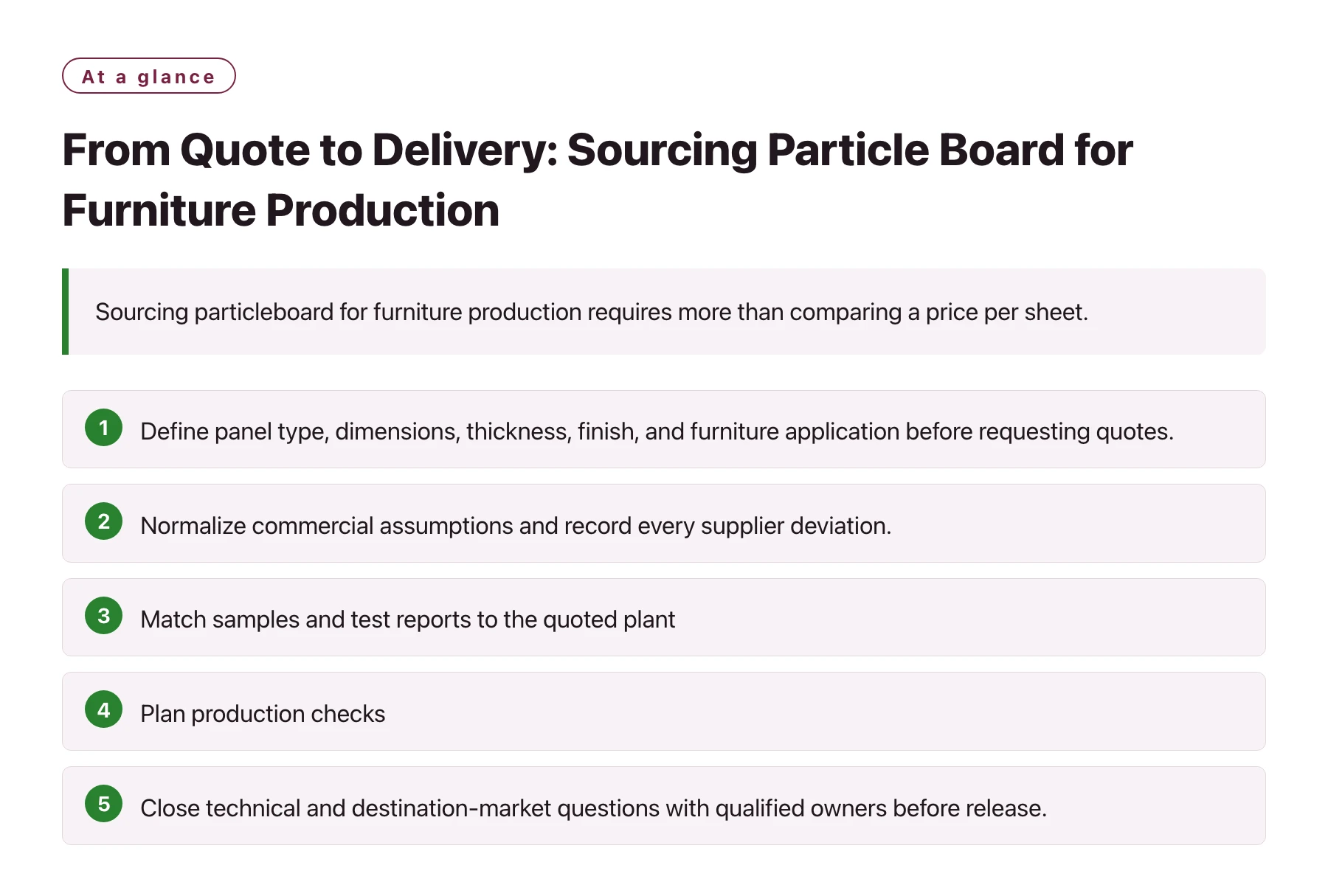
Key takeawaysDefine panel type, dimensions, thickness, finish, and furniture application before requesting quotes. · Normalize commercial assumptions and record every supplier deviation. · Match samples and test reports to the quoted plant, construction, and production scope. · Plan production checks, lot identification, packaging, and delivery evidence in advance. · Close technical and destination-market questions with qualified owners before release.
A quote-to-delivery workflow makes technical and commercial assumptions visible at every gate.
1. Translate the furniture design into a panel specification
Start with the furniture component and its function: cabinet side, shelf, drawer part, tabletop core, or another application. Specify panel type, nominal thickness and tolerance, sheet dimensions, density or performance needs, surface finish, edge treatment, machining, and moisture conditions relevant to storage and use. Note whether the panel will be laminated or supplied as a finished component. Identify the design drawing and revision that govern the order.
Separate mandatory properties from preferences. State which measurements, tests, emissions evidence, color match, or surface checks matter and who approves them. Avoid vague descriptions such as “furniture grade” without a defined standard or performance basis. If the designer has not specified an acceptance tolerance, send the question to the technical owner before asking factories to quote.
2. Request comparable supplier quotations
Send each supplier the same panel schedule, annual and initial volume, cutting or machining needs, packaging level, destination, delivery window, and document request. Ask for price by thickness, size, finish, and quantity break. Require suppliers to list minimum order quantities, tooling or setup costs, lead time, quote validity, payment terms, and exclusions. Clarify whether the offer is for raw panels, laminated sheets, or cut-to-size components.
Normalize delivery terms and cost assumptions before ranking offers. Add palletization, protective sheets, moisture protection, testing, inspection, export packing, inland transport, and freight separately where relevant. Record any substituted material or wider tolerance. A low unit price is not a saving if the buyer later pays for reprocessing, excess waste, or an unplanned finish operation.
3. Review standards and destination requirements
If a recognized standard is used, name its edition and the properties it addresses. ANSI A208.1-2022 is a voluntary North American particleboard standard sponsored by the Composite Panel Association; the association notes that it covers physical, mechanical, dimensional, and formaldehyde-related requirements. A reference to that standard does not automatically establish compliance in every destination or for every furniture application. [1]
Ask the importer or compliance owner to determine market-specific emissions, chemical, labeling, and construction requirements. If the furniture is sold into the United States, check current composite-wood obligations and whether panels or finished goods fall within scope. For other markets, use the relevant rules and standards. Keep regulatory review separate from the supplier’s generic certificate or catalogue claim.
4. Approve a sample that represents production
Request a sample from the intended factory and product construction. Label it with supplier, plant, item code, dimensions, finish, revision, and date. Measure agreed features and check the surface, edges, machining quality, bonding or lamination where applicable, and compatibility with the furniture process. Record which properties the sample can demonstrate and which need a report or production check.
If the sample is hand-selected or specially finished, ask whether routine production can match it and how. Retain a reference sample or approved images and measurement record. Define who may approve a change to core, resin, surface paper, thickness, source, or process. A replacement sample should not silently overwrite the approved reference; preserve revision history and decision dates.
5. Verify supplier and process capability
Confirm the contracting entity, production site, and responsibility for panel manufacture, finishing, cutting, and export. Ask about line capacity, thickness range, surface options, raw material sourcing, process monitoring, test equipment, minimum runs, and current loading. If the supplier uses another plant or subcontractor for a process, identify that site and how changes are controlled.
Request evidence suitable to the risk: process description, lot identification, inspection records, test reports, or a site review. Check that documents name the same product and factory as the offer. Ask how out-of-limit panels are segregated and who authorizes release. A quality-system certificate alone does not prove that this order will meet the specification.
6. Monitor production and lot consistency
Place production checkpoints where findings can still be corrected: incoming material, first output, routine process records, finished panel checks, or finished furniture component inspection. Choose the method and sample size with the quality owner based on risk and contract. Record batch, dimensions, measured results, surface observations, test evidence, and any deviation. Do not infer unmeasured physical properties from a visual check.
If the panel is cut or laminated downstream, trace the original panel lot through the conversion process. Record which furniture components use each lot and how offcuts or replacements are handled. When the factory proposes a new source, construction, or standard, require a documented change review before the substitute enters production.
7. Protect panels through packing and transit
Agree pack size, pallet dimensions, stack limits, edge protection, interleaving, moisture barrier, wrapping, and handling marks according to panel dimensions, route, and receiving equipment. Check that the packaging protects finished faces and edges without trapping unwanted moisture. Confirm whether lifting access and pallet weight suit the importer’s warehouse and furniture factory.
Before dispatch, reconcile sheet or component counts, dimensions, lot identifiers, pallet marks, and packing list. Photograph representative packaging and the final load. State how damaged or wet panels will be segregated and reported at receipt. If goods arrive in phases, assign lots to each shipment so furniture production can maintain material consistency or intentionally segregate variants.
8. Confirm delivery and close the record
At receipt, count panels or bundles by the agreed unit, verify marks and lot identity, and inspect packaging for visible damage. Sample measurements should follow the agreed plan. Compare actual materials with the approved specification, sample, and shipment documents. Record damage, quantity variance, surface issue, or uncertain identity before panels are distributed to cutting or assembly lines.
Close each purchase line only after open technical, document, quantity, and damage issues have a disposition. Keep the approved specification, sample record, supplier quote, production evidence, inspection report, packing list, and receiving notes together. Buyers sourcing Learn more about particleboard procurement can use the technical sourcing guide as a starting point, then adapt its scope to the furniture design, market, and order risk.
Sources
Frequently asked questions
What should a furniture buyer specify for particleboard?
Define panel type, thickness and tolerance, dimensions, finish, edge treatment, machining, intended use, test needs, packaging, and lot identification. Link each requirement to the current drawing or schedule.
Does ANSI A208.1 apply to every destination market?
No. It is a voluntary North American industry standard. Ask a qualified owner to determine whether it is contractually relevant and what other destination rules apply.
Can a supplier sample guarantee consistent production panels?
No. It supports review of a specimen. Confirm process controls, lot traceability, production checks, and agreed acceptance rules to manage variation across later output.
What records should be retained through delivery?
Keep the approved specification and sample, quotation, factory and test evidence, production or inspection records, packing list, lot identifiers, receiving results, and dispositions for every open issue.